Talks
2025
-
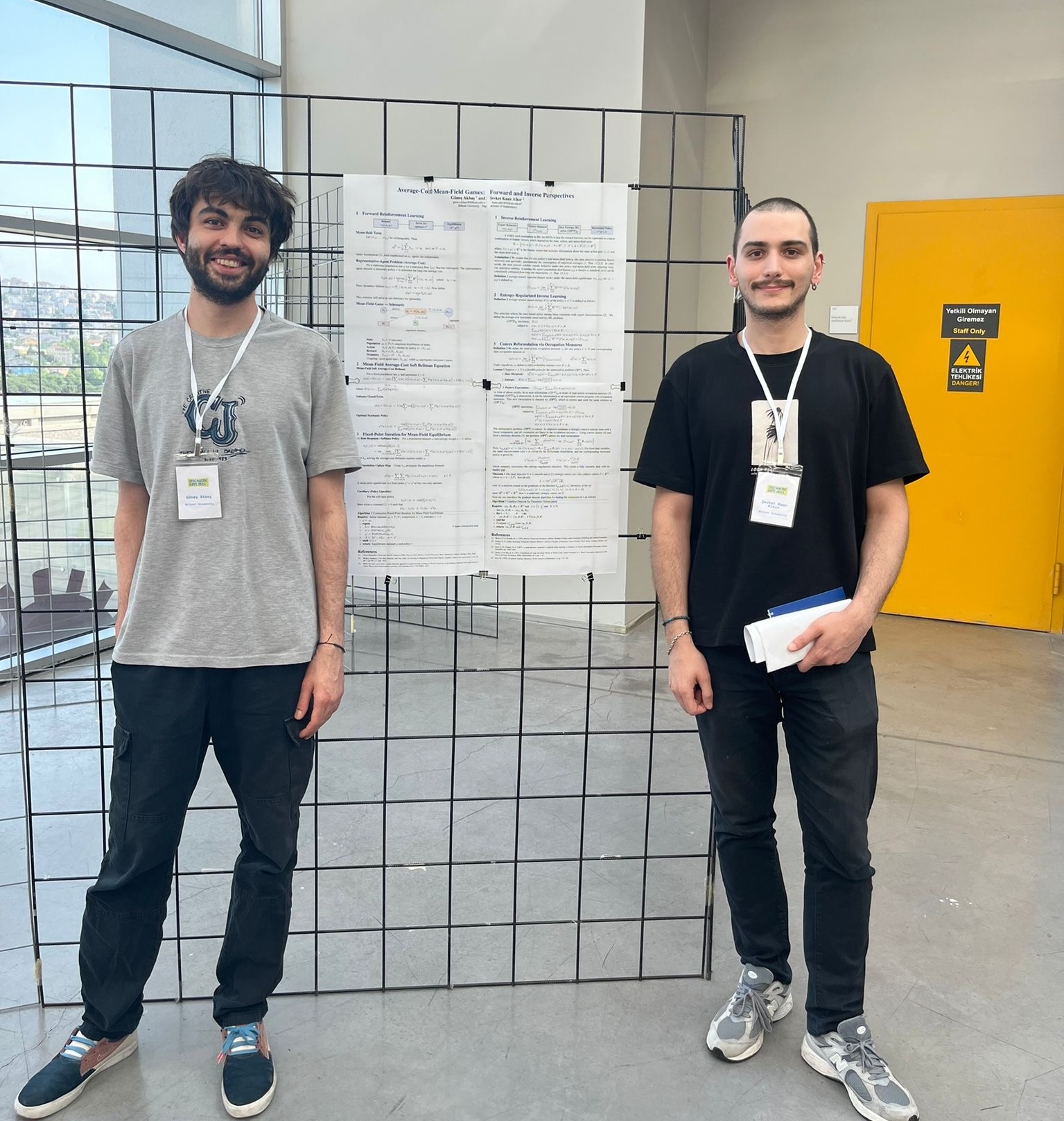
Average-Cost Mean-Field Games: Forward and Inverse Perspectives
Stocastic Days, Özyeğin University 24 June
This work investigates entropy-regularized control and inverse reinforcement learning in infinite-horizon mean-field games under an average-cost criterion. On the forward side, we analyze the entropy-regularized Bellman equation and characterize the optimal policy via a closed-form soft-max representation. Under standard regularity assumptions, we establish contraction properties that guarantee convergence of fixed-point iterations to a mean-field equilibrium. In the inverse setting, the objective is to infer the reward function from expert demonstrations that are optimal with respect to an unknown cost structure. Within the same entropy-regularized framework, the inverse problem is reformulated as a convex program over occupation measures. We derive a dual formulation that is smooth and strongly convex, and propose a first-order solution method that recovers an equilibrium policy consistent with the observed data. -
Reinforcement Learning for Mean-field Games with Average Reward Criterion
Analysis Seminars, Bilkent University 22 April
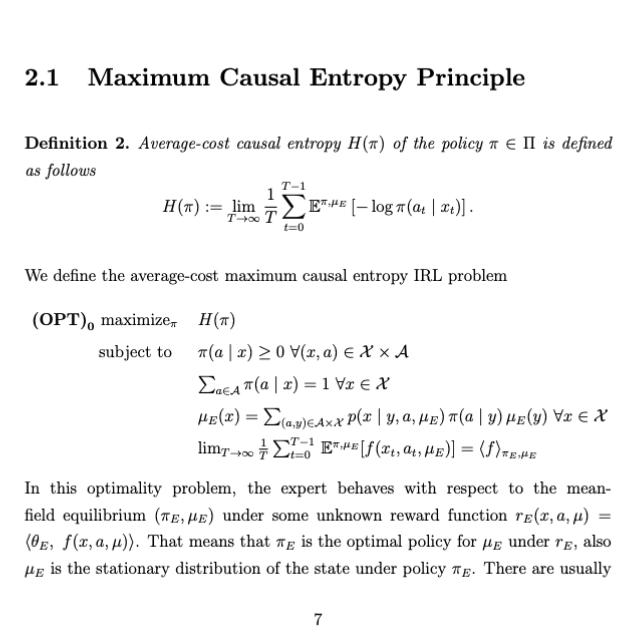
We study the inverse reinforcement learning (IRL) problem for discrete-time, infinite-horizon mean-field games (MFG) with an average-reward criterion. Unlike the forward setting, where the reward function is known, IRL assumes access only to expert demonstrations that are optimal under some unknown reward function. The objective is to recover the reward structure that explains these expert behaviors. Our approach is based on the maximum causal entropy principle, which selects the least biased policy among those consistent with the observed demonstrations. We show that the resulting non-convex formulation is equivalently reformulated as a convex optimization problem over occupation measures. Furthermore, we establish that the dual objective is smooth and strongly convex over compact sets and derive a variational representation using a log-partition formulation. Finally, we propose a first-order algorithm for solving the dual problem and recovering an entropy-maximizing equilibrium policy.
2024
-
Grover’s Search Algorithm
Quantum Computing Class, Bilkent University 09 December
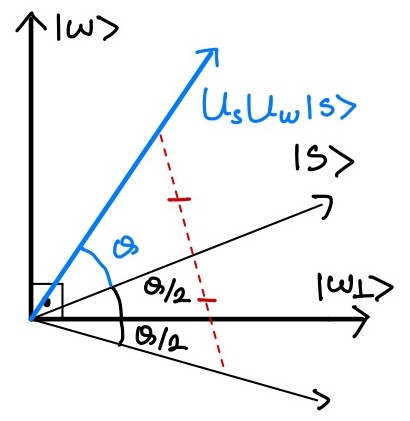
This presentation introduces Grover’s Search Algorithm, a cornerstone quantum algorithm that offers a quadratic speedup over classical linear search methods. We begin by formulating the unstructured search problem and analyzing the inefficiencies of classical approaches. Grover’s algorithm is then developed step-by-step, highlighting its initialization through Hadamard gates, the iterative amplitude amplification process using oracle and diffusion operators, and the final measurement phase. Key concepts such as the geometric interpretation in the $|\omega\rangle - |\omega^{\perp}\rangle$ plane and complexity analysis are also discussed. The algorithm’s runtime of $\mathcal{O}(N)$ demonstrates the significant advantage of quantum computation in search problems.
2023
-
Frobenius Algebras
Representation Theory Class, Bilkent University 21 December
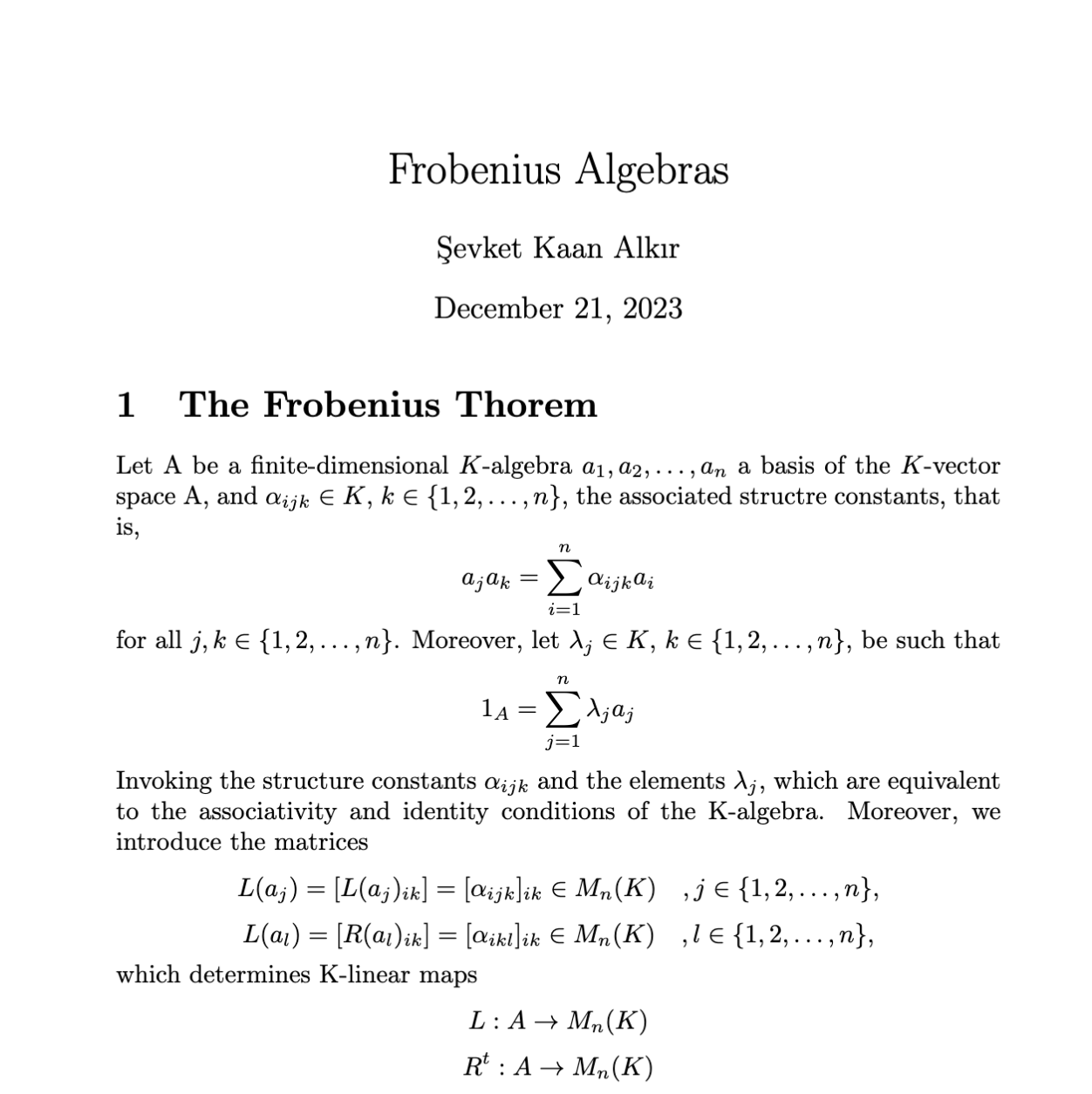
This talk provides an introduction to Frobenius algebras—finite-dimensional algebras over a field K whose left and right regular representations are equivalent. We begin by revisiting Frobenius's original characterization via parastrophic matrices and then present modern, basis-independent criteria due to Brauer, Nesbitt, and Nakayama, including the existence of nondegenerate associative bilinear forms. We explore the distinction between Frobenius and symmetric algebras, the role of the Nakayama automorphism, and the structural consequences such as self-injectivity. The talk emphasizes both classical motivation and categorical formulations, aiming to bridge algebraic structure with representation-theoretic insights.
2022
-

Multi-Criteria Decision Making: SMART and VIKOR Methods
ZOOM, Ankara University 15 June
Many scientific techniques are used for decision making. While there are many informal and non-empirical methods applicable in specific areas, these do not generalize well to a broader context. However, using mathematical methods offers a universal approach for selecting the best alternative in any domain. This project introduces two frequently used Multi-Criteria Decision Making (MCDM) methods—SMART and VIKOR—and presents illustrative case studies.